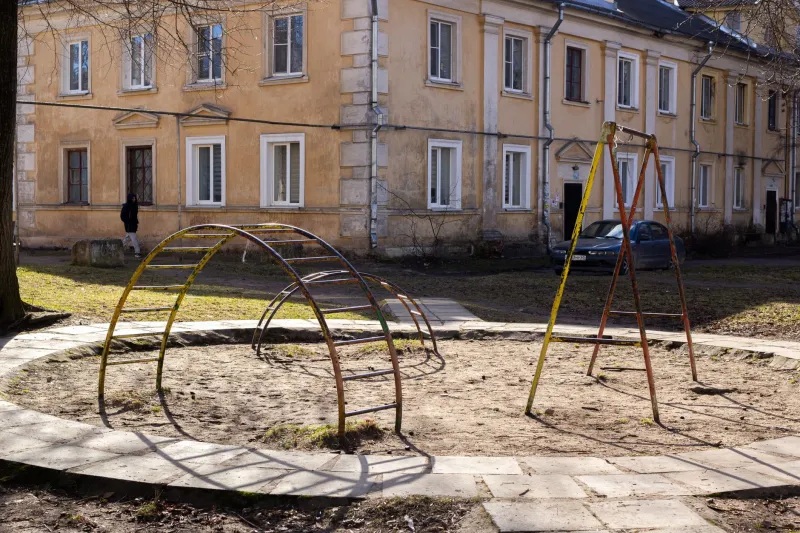
If you grew up in America before about 1985, you almost certainly have a scar you can point to and trace back to a specific piece of playground equipment. Maybe it's from a metal slide that spent the morning absorbing July heat before depositing you at the bottom with second-degree burns on the backs of your thighs. Maybe it's from a merry-go-round that spun fast enough to achieve something approaching escape velocity. Maybe it's just a vague memory of gravel, and pain, and getting up and doing it again.
Those playgrounds are almost entirely gone now. What replaced them is safer, cleaner, and engineered to within an inch of its life. Whether it's better is a question worth asking.
What Those Old Playgrounds Actually Looked Like
The classic American playground of the postwar decades was a study in cheerful indifference to risk. Metal was the material of choice — painted steel that rusted at the joints and got hot enough in summer to brand you if you grabbed it wrong. Jungle gyms routinely reached ten or twelve feet. Slides were steep and fast. Swings had real momentum and real metal chains that could catch a finger if you weren't paying attention.
The merry-go-round deserves its own paragraph. This was a piece of equipment that required cooperation, physics, and a certain tolerance for centrifugal force. Someone had to push. Everyone else had to hold on. If you let go at the wrong moment, you were going somewhere the equipment didn't intend. Falls from playground equipment in this era typically ended on packed dirt, asphalt, or loose gravel — surfaces that provided essentially no cushioning and excellent feedback on the consequences of miscalculation.
Nobody designed these playgrounds with injury in mind. But nobody designed them around the assumption that injury was unacceptable, either. The implicit understanding was that kids would get hurt sometimes, that getting hurt was survivable, and that a playground that couldn't hurt you probably wasn't doing much for you.
The Liability Shift
The transformation didn't happen overnight, and it wasn't driven purely by safety data. It was driven by lawsuits.
Through the 1970s and into the '80s, personal injury litigation around playground equipment expanded significantly. Individual injuries that might once have been absorbed as accidents became legal cases. School districts and municipalities, facing mounting liability exposure, began removing the most dangerous equipment first — the tall metal slides, the merry-go-rounds, the see-saws with the real pinch potential at the fulcrum.
The Consumer Product Safety Commission published its first playground safety guidelines in 1981. They were voluntary, but the insurance industry noticed. By the late '80s and through the '90s, a new generation of playground equipment was being designed from scratch around the guidelines: maximum fall heights, impact-absorbing surfaces, no entrapment hazards, no moving parts that created crush risks. The rubberized surface — wood chips first, then poured rubber — became standard. The equipment got lower, slower, and rounder.
 Photo: Consumer Product Safety Commission, via cdn.forumcomm.com
In purely actuarial terms, it worked. Playground injury rates dropped. Emergency room visits for playground-related injuries declined over the decades. The equipment was genuinely safer.
But What Did Safe Actually Cost?
Here's where the story gets more complicated, and where researchers started asking questions the liability lawyers hadn't thought to raise.
Developmental psychologists and child development researchers began accumulating evidence that risk in play isn't an unfortunate side effect — it's part of the mechanism. Children who engage with genuinely challenging physical environments develop better spatial reasoning, more accurate risk assessment, greater confidence in their own physical capabilities, and stronger resilience when things go wrong. The scrape that teaches a kid exactly how fast is too fast on a particular surface is not a failure of the playground. It's the playground working.
Norwegian researcher Ellen Beate Hansen Sandseter, whose work on risky play became influential in the field, identified categories of risk that children are naturally drawn to: heights, speed, rough-and-tumble play, being near dangerous elements like water or fire, experiencing the sensation of getting lost or separated. Her research suggested these aren't bugs in childhood behavior. They're features — the way children calibrate their own relationship with the physical world.
 Photo: Ellen Beate Hansen Sandseter, via plusbog-v2-dk.s3.amazonaws.com
The American playground, optimized entirely for the prevention of physical injury, removed most of these experiences from supervised outdoor play. Kids who needed to encounter risk didn't stop needing it. They just stopped finding it at the playground.
The Boredom Problem Nobody Planned For
Walk through a modern playground on a weekend and watch what happens. The equipment gets used for about ten minutes. Then kids start doing something else — something not designed, not supervised, not rubber-surfaced. They climb the fence. They find a stick. They start roughhousing in a way that involves actual unpredictability. They engineer their own risk because the environment stopped providing it.
This isn't a new observation. Playground designers and child development researchers have been making it for two decades. The response has been a slow but genuine rethinking of playground philosophy in some corners of the field. "Adventure playgrounds" — a concept borrowed from Europe that involves actual loose materials, tools, and genuinely unstructured environments — have started appearing in American cities. Some school districts have experimented with recess policies that explicitly allow more physical risk.
But these remain exceptions. The dominant American playground is still a low-clearance, high-visibility, impact-surface structure that communicates, architecturally, that nothing too interesting is going to happen here.
Then What Now
The old playground probably did hurt more kids than the new one. That's not nothing. A fractured wrist is a fractured wrist, and nobody's arguing for a return to asphalt landing surfaces under twelve-foot jungle gyms.
But the question worth sitting with is whether the safety we built into American childhood came with a cost we didn't fully price in. Risk teaches things. Failure teaches things. Getting hurt, in a survivable way, on a Tuesday afternoon at the park teaches things that no amount of rubberized surface can substitute for.
The safest playgrounds in American history might also be the least honest ones. They tell kids the world is manageable and padded and unlikely to surprise them. Then the kids grow up and discover it isn't.