When Finding Your Way Was Actually Finding Your Way: How Americans Lost the Art of Navigation
When Finding Your Way Was Actually Finding Your Way: How Americans Lost the Art of Navigation
There's a moment that happens to everyone who grew up before GPS: you're driving somewhere unfamiliar, your phone dies, and suddenly you realize you have no idea where you are. Not just geographically lost — cognitively lost. Your brain, accustomed to being told exactly where to go, simply doesn't know how to figure it out anymore.
This wasn't always the case. For most of human history, navigation was a skill. Not a specialized one like piloting a ship, but a basic life competency, like cooking or balancing a checkbook. Getting somewhere meant knowing how to get there, and if you didn't know, you had to learn.
The Ritual of Route Planning
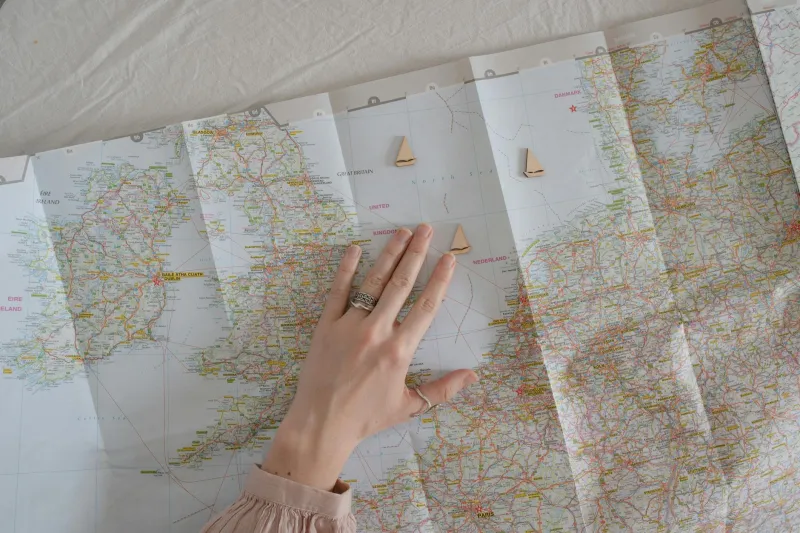
Before 2007, when the iPhone put turn-by-turn directions in everyone's pocket, planning a trip to somewhere new was an event. You'd spread a road atlas across the kitchen table — those massive, spiral-bound books that lived in every American glove compartment. With a highlighter, you'd trace your route, noting highway numbers and major landmarks.
For longer trips, you'd call ahead to hotels and ask for written directions from the nearest interstate. These handwritten notes, scrawled on hotel letterhead, were treasured documents. "Take Exit 47, turn left at the Texaco, we're the third building past the water tower." You'd study these instructions like they contained state secrets.
AAA TripTiks were the gold standard — personalized strip maps that showed your exact route, printed on sturdy cardstock and bound with a metal spiral. Members would visit AAA offices, where agents would manually highlight the best roads and mark construction zones with little orange stickers. Getting a TripTik felt like receiving official government documents for your journey.
The Social Currency of Directions
Asking for directions was a normal part of American social interaction. Gas station attendants were unofficial navigation experts, expected to know not just local roads but the best routes to neighboring cities. "You want to avoid Route 9 this time of day," they'd say, drawing a little map on the back of a receipt.
Even strangers on the street would stop to help lost travelers, often walking to your car window to point out landmarks. "See that red barn? Turn right there, then go about two miles until you see the church with the tall steeple." These interactions created tiny moments of human connection that we didn't realize we'd miss.
Restaurant placemats often featured local maps, and every hotel lobby had a rack of area maps and tourist guides. These weren't just decorative — they were functional tools that people actually used and studied.
When Getting Lost Was Expected
Here's what might surprise anyone under 40: getting lost used to be completely normal. Not just acceptable, but expected. You built extra time into every trip to account for wrong turns and missed exits. Getting lost was part of traveling, like packing snacks or checking your oil.
This acceptance created a different relationship with uncertainty. You'd drive down an unfamiliar road, realize it was wrong, and simply turn around. No big deal. You'd discover new neighborhoods, stumble across interesting businesses, meet helpful locals. Getting lost often led to getting found in ways you hadn't planned.
Families would pile into the car for Sunday drives with no particular destination, just exploring. "Let's see where this road goes," was a perfectly reasonable way to spend an afternoon. The journey was as important as the destination because the journey required active participation.
The Cognitive Shift
Navigation used to be an active mental process. You'd build a mental map as you drove, noting landmarks and memorizing the sequence of turns. "Left at the big oak tree, right after the bridge, straight for about five minutes." Your brain was constantly processing spatial information, building and updating your understanding of the landscape.
This created what psychologists call "spatial awareness" — an intuitive sense of direction and location. Most Americans over 50 can still point roughly north without thinking about it, estimate distances fairly accurately, and navigate familiar areas even without street signs.
Today's GPS navigation is fundamentally passive. You follow instructions without building understanding. The phone knows where you are and where you're going; you just need to do what it says. It's incredibly efficient and remarkably foolproof, but it's also cognitively empty.
What We Didn't Know We'd Lose
The shift to GPS navigation happened so gradually that we barely noticed what disappeared. Road atlases vanished from glove compartments. Gas stations stopped expecting customers to ask for directions. The skill of reading a paper map — once as basic as reading a clock — became as obsolete as using a rotary phone.
But we lost more than just navigation skills. We lost the small adventures that came from getting lost, the local knowledge shared by strangers, the satisfaction of successfully navigating to a new place through your own competence. We lost the mental exercise of spatial reasoning and the confidence that comes from being able to find your way.
Most significantly, we lost our tolerance for uncertainty. When your phone tells you exactly how long every trip will take, getting somewhere five minutes later than predicted feels like a failure. The GPS has made us more efficient, but also more anxious about the unknown.
The Efficiency Trade-Off
None of this is to say that GPS navigation isn't miraculous. It's saved countless hours, prevented millions of arguments, and made travel accessible to people who struggled with traditional navigation. You can now confidently drive to any address in America without any preparation or local knowledge.
But efficiency isn't everything. The old way of navigating was slower, more uncertain, and occasionally frustrating. It was also more human, more social, and more engaging. It required skills, created connections, and left room for serendipity.
Today, getting lost isn't an adventure — it's a system failure. When the GPS stops working, we don't feel challenged or curious. We feel helpless. We've traded the art of navigation for the convenience of automation, and most of us don't even remember what we gave up.
The next time your phone dies while you're driving somewhere unfamiliar, try to find your way without immediately looking for a charger. Notice how different it feels to navigate with your own brain instead of following instructions. You might discover that finding your way is more interesting than simply being told where to go.