Your Uncle Got You the Interview: The Era When Hiring Was a Handshake Away
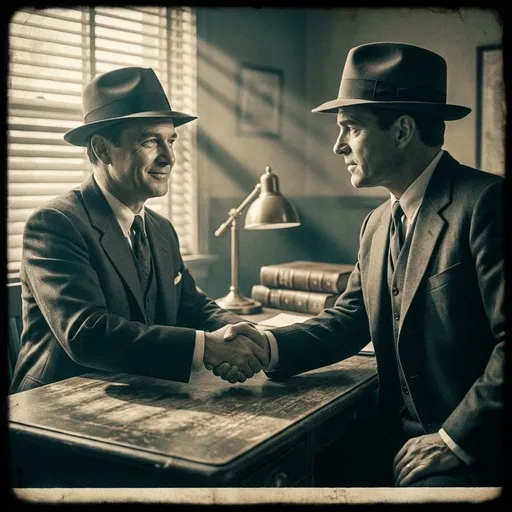
Photo: vintage job interview handshake hiring office mid century American, via images.stockcake.com
Somewhere in America right now, a qualified person is staring at a job application portal that asked them to upload a resume and then manually re-enter every piece of information from that resume into individual form fields. They'll submit it, receive an automated confirmation email, and never hear anything again. The position will be filled by someone whose application scored higher on a keyword algorithm they didn't know existed.
This is modern hiring. And it would be completely unrecognizable to someone who entered the workforce in 1955.
The Way It Actually Worked
For most of the 20th century, finding a job in America was a social exercise as much as a professional one. You heard about openings through people — your father mentioned something at dinner, your neighbor said the plant was taking on workers, your parish priest knew a foreman who owed him a favor. Word traveled through networks of people who knew each other, and the job often went to whoever arrived first with a credible reference attached.
Union halls were a central part of this ecosystem for blue-collar workers. If you were a member of the electricians' union or the steelworkers, you went to the hall, put your name on a list, and waited for a call. The dispatching system wasn't perfect, but it was transparent — seniority and skill mattered, and the process was managed by people you could actually talk to. If something went wrong, you could walk in and ask why.
For white-collar work, the dynamic was similar but more informal. Companies hired through personal connections and direct walk-ins. A young man might visit a company's front office, ask to speak with the hiring manager, and actually get the meeting. Resumes existed, but they were short — half a page, maybe a page — and they were supplements to the conversation, not gatekeepers before it.
The interview itself was a human encounter. A manager sat across a desk, asked some questions, sized up the candidate, and made a call based on instinct, reputation, and whatever the reference said when they picked up the phone. It was imprecise and personal in equal measure.
What the System Got Right
There's a reason people look back on this era with a certain nostalgia, and it's not entirely misplaced. When hiring was built on relationships, rejection was at least delivered by a person. You heard no from someone who'd looked you in the eye, not from a silence that lasted six weeks until you gave up checking your email.
The process also moved faster. Without layers of software screening, panel interviews, personality assessments, and committee approvals, companies made decisions in days rather than months. A worker who showed up with a solid recommendation and a willingness to start Monday could be employed by Wednesday. That speed had real value — for workers who needed income and for employers who needed to fill roles.
There was also a kind of accountability baked into the system. If your uncle vouched for you and you turned out to be unreliable, it reflected on him. That social pressure worked both ways — it meant referrals weren't made carelessly, and it meant the person being referred had real incentive to perform. The job came with a relationship attached, and you didn't want to embarrass the people who'd gone out on a limb for you.
What the System Got Badly Wrong
Here's where the nostalgia has to get honest. A hiring system built on personal networks is only as fair as those networks — and American social networks in the mid-20th century were stratified by race, gender, and class in ways that were enforced with brutal consistency.
If you were Black in 1950s America, the informal referral network that placed white workers in good union jobs was largely closed to you. Many unions explicitly excluded Black members. The foreman who hired based on who his buddy vouched for wasn't going to vouch for someone who didn't look like him. Women were funneled into a narrow band of acceptable occupations regardless of their qualifications, because the men making hiring decisions had decided that's how things worked.
The warm handshake economy worked warmly for some people and like a locked door for everyone else. The personal nature of hiring wasn't neutral — it was a mechanism for reproducing existing social hierarchies with a friendly face on them.
Then What Now: The Algorithm That Replaced the Foreman
Modern hiring tried to fix the bias problem by removing the human. Applicant tracking systems, structured interviews, standardized assessments — the idea was that if you took personal judgment out of the equation, you'd get fairer outcomes. In some ways, it worked. Opportunities that were once informally reserved for certain groups became at least nominally accessible to anyone who could submit an application.
But the new system created its own dysfunction. Resumes are now screened by software that filters for keywords before any human sees them. A highly qualified candidate whose resume doesn't include the exact phrase the algorithm is looking for gets eliminated before a hiring manager ever knows they existed. Companies post positions they've already internally decided to fill, going through the motions of a process that was concluded before it started.
And the volume is staggering. Corporate job postings routinely attract hundreds of applications. Responding to all of them individually is genuinely impossible, so most applicants receive nothing — no feedback, no timeline, no acknowledgment beyond the automated email that their submission was received. The facelessness that was supposed to reduce bias has also eliminated basic human courtesy.
The Uncomfortable Middle Ground
The honest answer is that neither system was good enough. The old way was human and fast and riddled with discrimination. The new way is scalable and formally accessible and frequently dehumanizing.
What's interesting is that personal referrals never actually went away — they just moved. Studies consistently show that a significant share of jobs are still filled through connections rather than open applications. LinkedIn formalized the network, but the underlying dynamic is the same one that worked in 1955. Who you know still matters. It just now comes with a profile photo and an endorsement section.
Maybe the real question isn't which system was better. It's whether we've ever actually built one that was both fair and human at the same time — and what it would take to try.