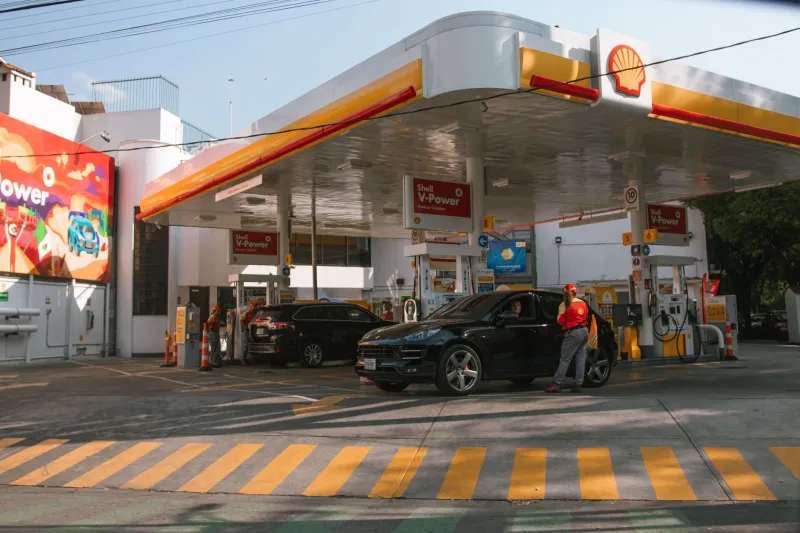
Pull off any American interstate today and the gas station experience is more or less identical whether you're in Montana or Mississippi. You tap your card at the pump, fill the tank, maybe grab a plastic-wrapped something from inside, and you're back on the road inside of four minutes. Efficient. Frictionless. Completely forgettable.
It wasn't always like this. For most of the twentieth century, stopping for gas on a road trip was an actual event — a small but genuine interruption in the journey that involved real people, real conversation, and a version of hospitality that has mostly vanished from the American road.
When the Pump Attendant Came to You
For anyone who drove in America before the mid-1980s, the full-service gas station was simply how things worked. You pulled in, and someone came to you. Not a screen, not a speaker — a person, often in a uniform with their name stitched above the pocket, who would fill your tank, check your oil, clean every window on your car, and sometimes check your tire pressure without being asked.
This wasn't a premium service. It was just service. The cost of gas included the labor, and the labor included a brief human exchange that road-weary travelers often genuinely appreciated.
For families driving cross-country in the days before air-conditioned minivans and portable DVD players, the gas stop was a natural rest point. Kids piled out and stretched. Moms organized the cooler. Dads talked to the attendant about road conditions ahead, whether the mountain pass was clear, which diner in the next town was worth stopping at. The attendant often knew. They talked to dozens of travelers a day and accumulated a working knowledge of the roads, the weather, and the local landscape that was genuinely useful.
These weren't anonymous transactions. In smaller towns, the gas station attendant was a minor community institution — someone who knew the regulars, tracked the gossip, and could tell you more about local road conditions than any map.
The Architecture of the Stop
The physical design of the mid-century gas station reflected its social function. Many had a small garage bay where minor repairs could happen while you waited. There was usually a soda machine — the kind with actual glass bottles in a chest of ice water — and sometimes a restroom that, while not glamorous, was at least available. A few had picnic tables out front.
Families who packed their own lunches — and most of them did, because eating out on a road trip was a special-occasion expense — would sometimes eat at those tables. The gas station wasn't just a fuel stop. It was a waypoint, a place to briefly belong to somewhere before getting back on the road to somewhere else.
The interaction between traveler and attendant carried a kind of informal hospitality. Tips weren't expected but were sometimes given. Directions were offered freely. If something seemed wrong with your car, the attendant would tell you — not to upsell you on a service, but because that was part of the job.
How Self-Service Changed Everything
Self-service gas pumps began appearing in the 1970s, initially controversial enough that several states banned them outright. New Jersey held out until 2023. Oregon until 2024 in rural counties. The resistance wasn't just nostalgia — there were genuine arguments about job loss, safety, and the erosion of a service culture that had defined the roadside experience for generations.
But the economics were hard to argue with. Self-service was cheaper to operate, faster for customers, and required far less labor. By the late 1980s, full-service stations had become a rarity outside of luxury contexts. By the 1990s, the gas station had largely completed its transformation into something closer to a convenience store with pumps attached.
The convenience store model brought its own logic. You could now get coffee, snacks, lottery tickets, and a rotating selection of items that had nothing to do with driving. The stop became more transactional but also more self-contained. You didn't need to talk to anyone if you didn't want to. Which, increasingly, people didn't.
What the Efficiency Cost Us
The modern gas stop is faster in every measurable way. You spend less time, spend less effort, and can complete the entire transaction without making eye contact with another human being. For people running late, or driving alone, or simply not in the mood for small talk, this is a genuine improvement.
But something was lost in the optimization. The gas station used to be one of the places where the American road trip had texture — where the journey wasn't just the distance between origin and destination but the accumulation of small moments and brief connections along the way.
The attendant who wiped your windshield and told you to watch out for deer on the highway past Flagstaff was, in a small way, part of your trip. They existed in the story you told when you got home. The pump you interact with today does not.
Road trips haven't disappeared — Americans still log hundreds of millions of them every year. But the rhythm has changed. The stops are faster, the interactions fewer, and the sense that you're passing through a place rather than just a coordinate on a GPS has grown harder to find.
Somewhere between the full-service pump and the tap-to-pay terminal, we traded a little bit of the journey for a faster arrival. Whether that was the right trade depends on what you thought the drive was actually for.